It took me a game of Wingspan to realise why I hated the way I vibe coded.
It’s 2am and I’ve been staring at the luminescent pharaoh smiski above my monitor for a while now. It’s Round 2, with 5 turns left. I’m trying to decide if I should play the American Golden-Plover (Wingspan: America Expansion) or the Himalayan Monal (Wingspan: Asia Expansion). I could either start ramping up my egg production or play the food giver for everyone, and in the process, still achieve what I want.
Each bird card that I am aiming to play consumes 2 types of food on average which gives me more flexibility to take other main actions like “Play a Bird”, “Lay Eggs” or “Draw Cards”. I might be helping the other players, but at least my ‘engine’ is ramping up both food and egg production. The Himalayan Monal (Wingspan: Asia Expansion) it is. I need more cards. With my current production cycle, I’m limited by my hand size.
Compared to the other players, I draw more cards for every “Draw Card” action I take, unless luck is on their side. Well, ‘players’. I’m essentially playing with the Automa, or as the gamers call it, bots. Anyways, now I have a higher chance of drawing a card that will fit into my strategy, to give me more resources, to play more bird cards, to get more points, to beat the bots. Another game, another scenario, another sleepless night. I’m obsessed with this. With deciding what comes next. With watching a thing I built start to feed itself. Once my mind is hooked on something, it’s all I ever think about. The last thing I was obsessed with was vibe coding.
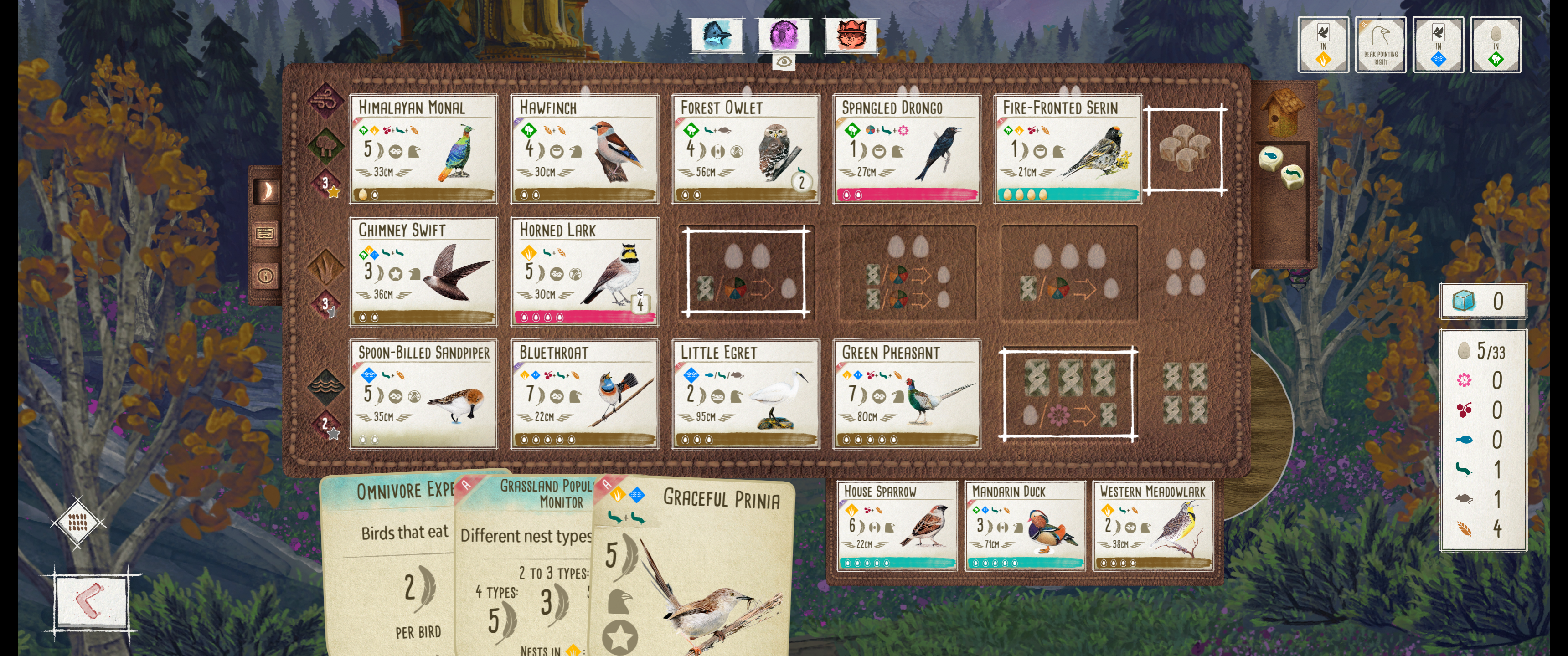
Two weeks ago, I booted up Wingspan for the very first time. Wingspan is a card-driven engine board game designed by Elizabeth Hargrave and published by Stonemaier games. It’s hard not to be lured in by the realistic coloured-pencil illustration of a Scissor-tailed Flycatcher on the box cover. The art was primarily created by two Colombian illustrators, Natalia Rojas and Ana María Martínez Jaramillo. I found out that Steam had a digital port of the game and it was also Steam Deck compatible, which made purchasing the game a no-brainer. I also heard that it was a good start for people who have been recently introduced to the world of board games. I booted up the game and took a pause to admire the gorgeous visuals that have been seamlessly transferred onto a screen. A mini pop-up asked if I need a tutorial and the rest is history.
“Legends said these tiny birds would hitch a ride in the tail feathers of eagles or owls.”
Goldcrest · Wingspan, European ExpansionIn this case, I am a tiny human, trying to hitch a ride in the NVIDIA GPUs of Anthropic. Like many people who got infected by the hype around Large Language Models (LLMs), I too have started my own passion project. What set me on my path was the initial buzz around OpenClaw, and how it was the next big thing.
It took me 4 to 5 hours of fiddling with command line interfaces, Tailscale, and copy-pasting code that to this day I don’t understand, to create Odysseus. Yes, I named my personal assistant Odysseus. I was reading Homer’s The Odyssey at the time in preparation for Christopher Nolan’s upcoming film adaptation. The story revolves around the many different side quests that Odysseus goes through, which I also hoped to go through with my new personal assistant so … you get the idea. Every time I thought of a random idea I would jot it down into my Notes app and revisit it after work. Then, Anthropic shut it all down.
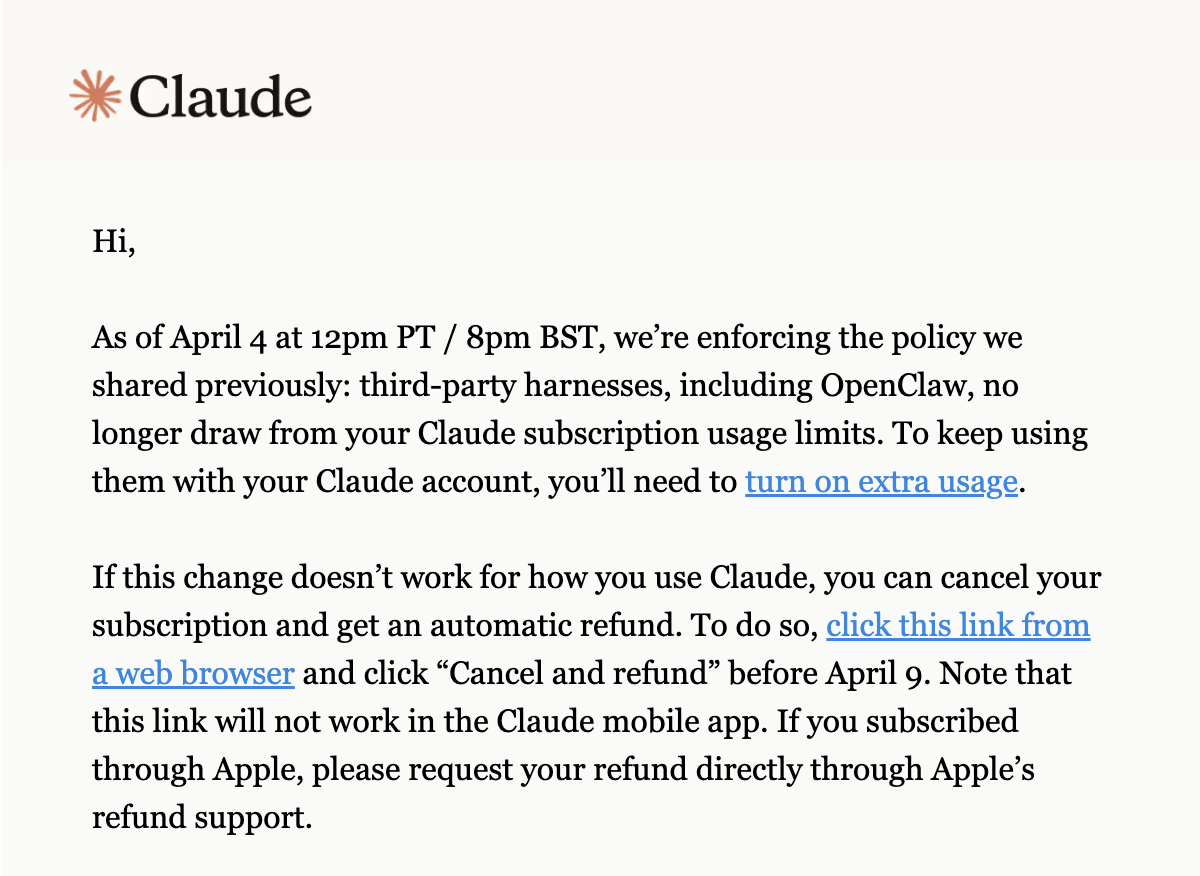
Goodbye Odysseus.
I absolutely love horror games. I am also a huge fan of Fooster, and that was how I started building my passion project, the Indie Horror Radar. Depending on when you are reading this article, the project may or may not be completed. I built it to help YouTube horror game streamers discover potential games early, based on a data-driven system that surfaces quality indie horror games before the mainstream market is made aware of them.
Like many others, I started with prompt engineering. I don’t have software development experience, but I’m a data analyst in my 9-5, so I thought website development would be the least of my problems since Claude would be doing most of the heavy lifting. I had an overarching idea of what kind of data I wanted, APIs that I needed, the frequency of data refreshes, what metrics I wanted to calculate and how I wanted the website to look. I never gave Claude full access to do whatever it wanted without my permission, but as time went on, I might as well have given it full permissions. Whenever the prompt popped up to ask for permission, all I did was click “Always Allow”. This went on for a long time. Time and time again, I would write these long prompts to “improve the user experience”, “improve the metric calculation”, “create an AI agent to validate the data after the pipelines have run”, and many more. I knew what I was trying to achieve, but I was slowly losing my understanding and grasp of the entire project. And like many beginners, I faced scope creep and lost sight of what the project was supposed to accomplish. I was drowning in lingo that I did not understand. Claude told me to do XYZ and all I did was push a button: “Always Allow”. Like tragic break ups, I slowly drifted away from my passion project and I didn’t know why. Every time I started a new session with Claude, I felt like I’d rather work on something else. My mind was always wandering. That’s when I realised that I fell out of love with my passion project.
Having spent a decade fighting the Trojan War, Odysseus seeks to return home. However, he spends another decade trying to get home due to divine intervention and obstacles. Side quests, as I’d call them. I had many different ideas and I wanted to work on them all, now that productivity is propelled ten-fold. After the OpenClaw incident, Claude became Odysseus for me. I say ‘for me’ because I was supposed to be the one who would go through the many trials and tribulations of building a product. Instead, I was like Fate, directing Odysseus on his journey. And in doing that, the only thing I was concerned with was the end product. I didn’t care about the journey.
The caveat being, we needed to go through 22 films, to flesh out each character arc, to fully appreciate the emotional weight of what it meant for the Marvel universe after Avengers Endgame. I outsourced the journey, the lessons learnt, and the thought process. I never intended for Odysseus’ journey to not be mine, but when a decent looking end product could be spun up within a day or two, it was difficult to not relent and take the path of least resistance. It became a habit: turn off my brain and prompt Claude with “play devil’s advocate then tell me” or “debate among the agents then tell me” instead of thinking for myself. My friends would know me as somebody who is very against doom-scrolling. But more than that, I am afraid of losing my cognitive ability. No doubt, I have reaped the benefits of productivity gain by using Claude at my full-time job. Building data pipeline ingestions, implementing checks for data quality, creating code documentation and a development log, you name it. I review Claude’s thinking and stay involved in the building process every step of the way. At my day job, I collaborate with Claude. But with my passion project, I lose that involvement. Or I guess, I chose that path. Nothing’s stopping me from asking Claude to walk me through the architecture — except me.
I fell out of love with my passion project. Playing Wingspan made me realise that I love being involved in the process and learning new things. And I fell out of love because I let myself go and didn’t give myself a chance to understand what was going on. I love learning how I can chain the American Golden-Plover (Wingspan: America Expansion) and the Little Egret (Wingspan: Asia Expansion) to build my engine to gain more points. Sure, winning is great. But, I love that little light bulb moment when something clicks and works. And that’s why I hated the way I vibe coded. Instead of doom-scrolling while waiting for Claude to spit out a solution, I’ll stop clicking “Always Allow” and stare at my Pharaoh Smiski instead.